
Beyond Keywords: Mastering Generative Engine Optimization (GEO) for Canadian Performance Marketing.

Clark Martin
Author
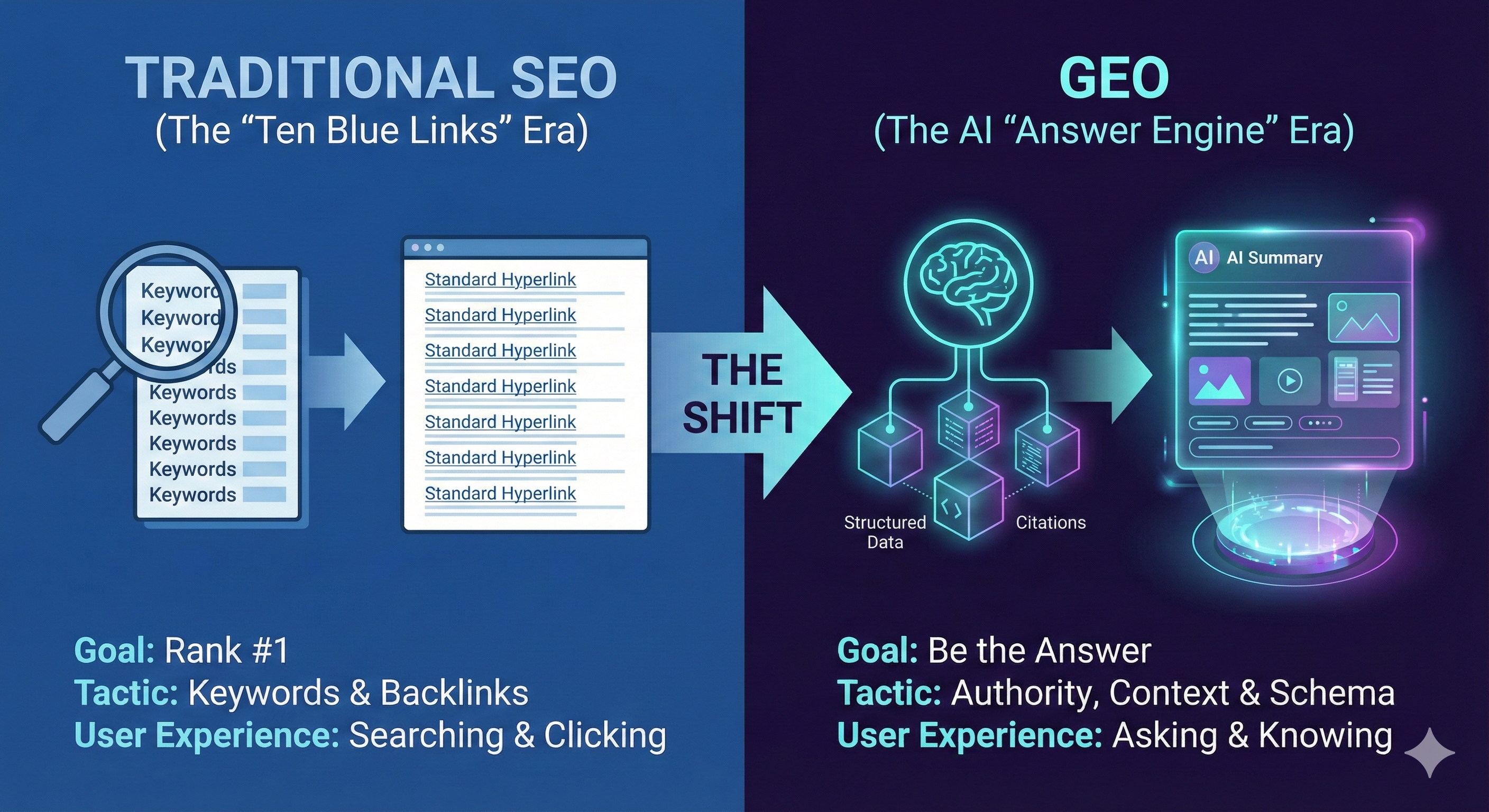
The digital landscape in Canada is undergoing a seismic shift. For over a decade, performance marketers have lived and died by the "ten blue links" on a search results page. But as we close out 2025, a new reality is setting in.
We are moving from the age of Search Engine Optimization (SEO) to Generative Engine Optimization (GEO).
With platforms like Google’s AI Overviews and conversational search tools becoming the default for millions of Canadians, the goal is no longer just to "rank"—it is to be the answer.
What is Generative Engine Optimization (GEO)?
GEO is the process of optimizing your content not just for a crawler, but for a generative AI engine. Unlike traditional search, which acts as a librarian pointing you to a book, generative engines act as researchers—they read the books and summarize the answer for you.
If your brand’s content isn't structured, authoritative, and easy for an AI to digest, you risk being "optimized out" of the conversation entirely.
Key Stat: Early data suggests that AI-generated answers can reduce click-through rates to traditional websites by up to 30%, but increase conversion intent for the traffic that does click through.
The Canadian Context: Why This Matters Now
Canada has always been a unique digital market—highly connected yet distinct from the US.
- High AI Adoption: Canadian consumers are adopting AI-assisted shopping tools faster than many global counterparts.
- Privacy First: With Bill C-27 and stricter privacy regulations, performance marketers can no longer rely on third-party cookies. GEO relies on content quality and context, not invasive tracking.
(Image Prompt: Nano banana style. A stylized map of Canada made of interconnected glowing optical fibers and floating data nodes. The nodes are pulse-lighting in sync, representing a connected, AI-driven network across the provinces.)
3 Strategies to Win at GEO in 2026
1. Optimize for the "Long-Tail Conversation"
Keywords are static; conversations are dynamic. Users are no longer typing "best winter boots Canada." They are asking, "I need waterproof boots for a Toronto slushy winter that look good with a suit."
- Action: Update your FAQs and product descriptions to answer specific, complex questions. Use natural language that mimics how real people talk.
2. Become the "Citation Authority"
Generative engines prioritize sources they trust. They look for consensus across the web.
- Action: Focus on Digital PR. Get your brand cited by reputable Canadian news outlets and niche industry blogs. If the AI sees your brand mentioned as a leader by others, it is more likely to feature you in its generated snapshot.
3. Structure Your Data for Machine Readability
If an AI can't read your price, inventory, or specs, it won't recommend you.
- Action: Double down on Schema markup. Ensure your Product, Review, and FAQPage schemas are flawless. This is the language the AI speaks.
The "Creative Canvas" of Performance Marketing
Perhaps the most exciting shift is the visual one. 2026 isn't just about text; it's about the "Creative Canvas." Tools like Gemini’s Nano Banana are allowing users to search with images and video, expecting visual answers in return.
Your performance marketing assets must evolve. Static JPEGs are out; rich, interactive, and AI-ready visuals are in.
Conclusion: Adapt or Disappear
The transition to GEO doesn't mean SEO is dead—it’s just grown up. For Canadian businesses, the opportunity is massive. By optimizing for the answer engine, you aren't just capturing traffic; you're capturing trust.
Ready to audit your site for the AI era?: Get your complimentary GEO Readiness Score today.
About Clark Martin
No bio available.
Read Next

Ladeena | Beauty E-Commerce in Saudi Arabia
See how we modernized Ladeena's digital presence in Saudi Arabia, bridging the gap between social discovery and website conversion through strategic design.

Accelerating Digital Brand Awareness for Dunlop MEA
Discover how we helped Dunlop MEA maintain its premium market position through high-impact visual communication, Instagram management, and targeted digital ads.
Scaling Organic Traffic by 1,000% for Myco
Learn how a data-driven SEO and content strategy drove Myco's organic traffic from 67k to 747k monthly visits in just five months.